01 · The premise
The registry records the meeting. The room is somewhere else.
Canada has a lobbying registry. It records only what the law forces into it: an arranged, spoken meeting that a registered lobbyist set up with an official. A dinner is not in it. A call the minister makes is not in it. The person who raises the party's money is not a lobbyist at all.
So this file starts from the room instead: the reception, the garden party, the evening in a private home, where the people who can pay the legal maximum stand within a handshake of the people who govern. In 2018 Parliament made those rooms public, down to the guest list. This is the first time the guest lists have been read together and set beside the money.
02 · The form
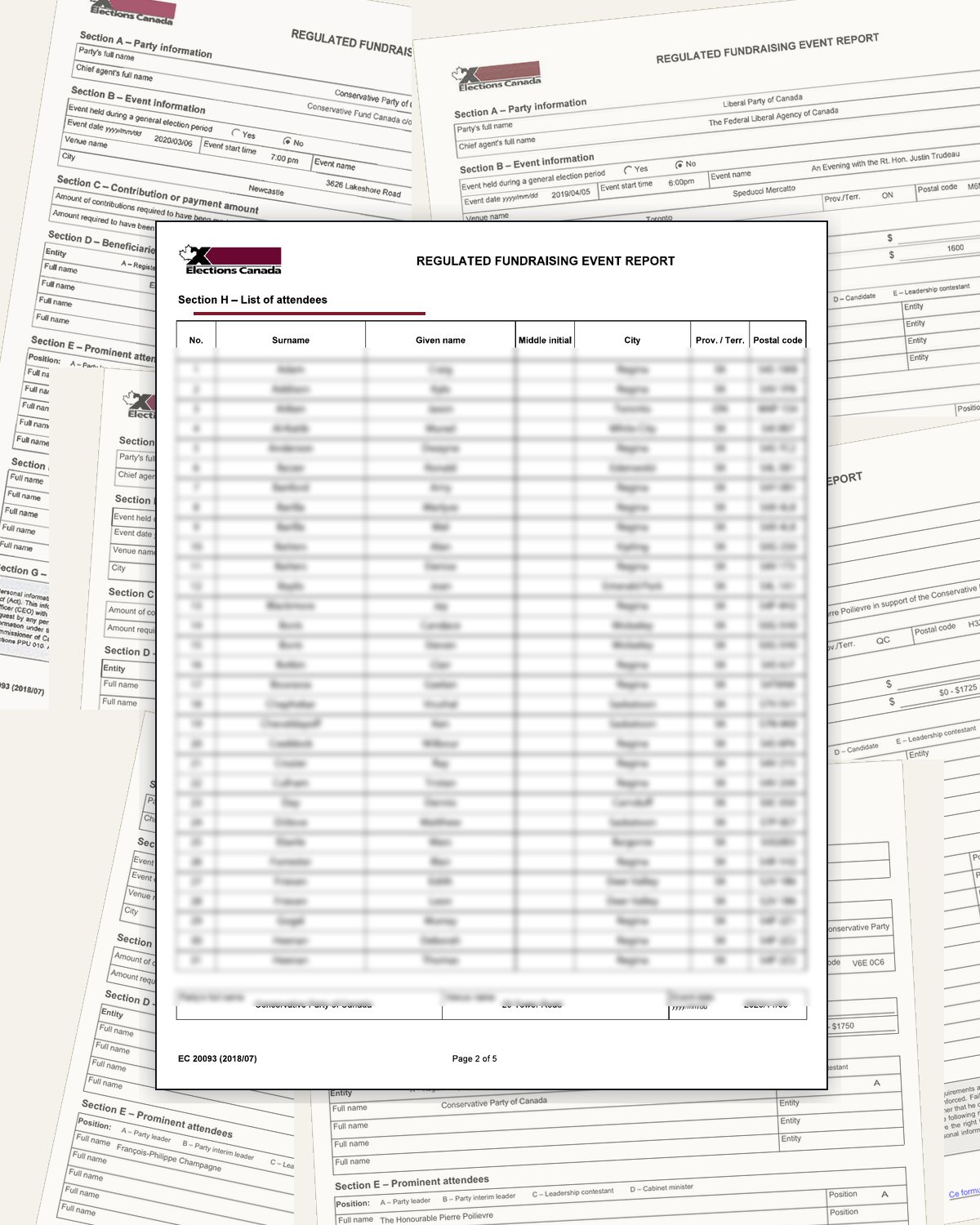
Eight sections. The last one is the list.
The report is form EC 20093. The law behind it, section 384.3 of the Canada Elections Act, says what it must contain, and the form follows the law line by line.
Section H is the guest list, and it is published. What the report does not say is what any one guest gave, or whether that guest lobbies the minister standing at the front of the room. The answer to the first question sits in a second Elections Canada database. The second sits in a registry run by a different office. The law never asks anyone to put the three side by side.
03 · The ledger
634 rooms, 46,862 seats.
Here is every room. Search a minister, a leader, a city or a party. Every row opens the report as Elections Canada published it, guest list included.
The busiest draws are the ones you would expect: Pierre Poilievre in 117 rooms, Justin Trudeau in 74, Erin O'Toole in 57. The Liberal Party also runs a standing club for donors who give the maximum. It is called the Laurier Club, and it is the name on 57 of these reports.
04 · The regulars
A small room, full of the same people.
46,862 seats sounds like a crowd. It is 33,488 people, and most of them came once.
The room belongs to the ones who come back. 938 people attended five rooms or more. They are 2.8 per cent of everyone on the lists and hold 14.4 per cent of all the seats. 150 people attended ten or more.
Some guests buy both sides. 281 people appear on Liberal and Conservative guest lists alike. A room is not a vote. It is a place to be seen by whoever governs next.
A guest is matched on surname, given name and the first three characters of the postal code, exactly as printed. Two people with the same name in the same postal area count once; one person who moved counts twice. The counts are a floor and a ceiling at once, and the method section says which way each one leans.
05 · The price
The ticket is the legal maximum. The public pays part of it.
A person could give a federal party at most $1,700 in 2023. 268 of the 568 priced rooms on file charge that year's ceiling, more than any other price.
The contribution database says who can pay it. In 2023, 3,282 people gave the Liberal Party at least ninety per cent of the maximum: 19.1 per cent of its named donors, 44.8 per cent of its named money. For the Conservatives it was 5,172 people, 11.3 per cent of named donors and 31.0 per cent of named money. For the New Democrats, 422 people and 13.1 per cent.
Now join the two lists. Of the guest seats we could match to a contributor, 54.6 per cent belong to someone who gave that party the maximum in that same year. The room is where the cap class goes.
What a maximum ticket costs, and who pays it
The credit is 75 per cent of the first $400, 50 per cent of the next $350 and a third of the rest, capped at $650 (Income Tax Act, s. 127(3)). On a maximum ticket the treasury pays 38 per cent of the door.
06 · The address
Private Residence. Then, no address at all.
In 73 reports the venue reads Private Residence
. The minister is named, the city is named, the guests are named. The person whose home it is appears only if the party lists them as an organizer.
48 of those rooms are Conservative and 25 are Liberal, and the Liberal ones have a start date. From January 2019 to October 2024 the Liberal Party filed 265 reports. Every one named its venue, a hotel, a restaurant, a hall or a video link, and not one said private residence. From November 2024 to May 2026 it filed 103, and 25 say Private Residence
.
Then Parliament took the address away. The Strong and Free Elections Act, given royal assent on 18 June 2026, rewrote the publication rule: a published report must limit the information on the location
to the municipality and the province. The same Act repealed the rule that made parties announce these events five days ahead. Before June 2026, 598 of 599 published reports named a venue. Since, none of 35 do.
The guest list survived the 2026 amendment. The address, and the notice that would have let anyone stand outside, did not. The same Act set the donor-disclosure threshold that The Laundering takes apart in Case 37, The Threshold.
07 · The list-keeper
His own cheque is capped. His list is not.
Stephen Bronfman became the Liberal Party's revenue chair in August 2013: its chief fundraiser, a volunteer post, held by a close friend of the leader. He was reported to have raised nearly two million dollars for that leader's 2013 campaign, and he was still described as the party's chief fundraiser in January 2025.
Look him up in the contribution record and he is one more name at the cap. Stephen R. Bronfman of Montreal and Westmount gives the Liberal Party about the legal maximum every year, alongside 3,282 other people in 2023 alone. Since the current limits took effect in 2007, his largest year is 2012, at $3,579, across the party, its riding associations and its leadership races.
Now look him up in the guest lists. His name is on 19 of them, from March 2019 to June 2026: Laurier Club receptions with the prime minister and with the finance minister of the day; five of the Club's summer garden parties at the Canadian War Museum, the latest on 8 June 2026 with Prime Minister Mark Carney and four members of his government; five of its December holiday receptions; a fundraiser with the energy minister, Tim Hodgson, at the Mount Royal Club in Montreal on 5 February 2026; and on 7 May 2026 an evening with the finance minister, François-Philippe Champagne, at a private residence in Westmount. In none of those 19 reports is he listed as an organizer. He is a guest, like everyone else in the room.
That is how the system is built, not a secret about one man. The money a revenue chair raises arrives under other people's names, one capped cheque at a time. The guest list shows he was in the room. It cannot show whom he brought, or whom he called to fill the other seats.
In 2017 the Paradise Papers tied Mr. Bronfman's family firm to a Cayman Islands trust set up by Leo Kolber, another long-time Liberal fundraiser. He said he had followed every rule, and the prime minister said he was satisfied. The Canada Revenue Agency's review has never been made public.
08 · Around the cap
Three ways past the ceiling, all of them on the record.
The foundation
On 19 May 2016 Prime Minister Trudeau attended a fifteen-hundred-dollar fundraiser at the Toronto home of Benson Wong. One guest, the businessman Zhang Bin, and a partner later gave a million dollars to the Pierre Elliott Trudeau Foundation and the Université de Montréal, two hundred thousand of it pledged to the Foundation. A foundation is not a party, so no contribution limit applied. The Foundation's chief executive and board resigned over the gift in April 2023, and the hundred and forty thousand it had received was returned. Those dinners are why the 2018 law exists.
The straw donor
From March 2004 to May 2011, SNC-Lavalin executives asked employees to give to federal parties and repaid them through fictitious bonuses and expense refunds: $117,803.49 in all, $83,534.51 of it to the Liberal Party of Canada itself. A corporation cannot give at all, so it gave through people who could. The contribution database recorded every cheque as a lawful personal gift. It took a compliance agreement with the Commissioner of Canada Elections, in 2016, to say otherwise.
The meeting nobody reports
Lobbyists report only spoken meetings arranged in advance. A meeting the official starts is not reported unless it is about a grant or a contribution. A company registers its in-house lobbying only if it is a significant part of an employee's duties. In March 2026 the Commissioner of Lobbying asked Parliament to remove that threshold. It is still in the Act.
09 · Three records
Each record is accurate. None of them is joined.
Set the three public records side by side and the design shows.
The event report
Names the draw, the city, the price and every guest. Not what each guest gave. Since June 2026, not the address.
The contribution record
Names everyone over two hundred dollars, with an amount and a date. Not the room the cheque bought.
The lobbying registry
Names the lobbyist, the official and the month, when a lobbyist arranged the meeting. Not the dinner, not the fundraiser, not the call the minister made.
This file joins the first two. The third, the registry, refuses automated access, so the question of how many guests at a minister's table are also registered to lobby that minister is still open. It is the next thing this file will answer.
10 · What the record would need
The list is already written. It only needs its columns.
None of this needs a new agency. Every missing join is one field on a form that already exists.
- An amount column on Section H. What each guest paid, so the list can be read against the contribution record without matching names by hand.
- The address back. The 2018 law published the venue and gave five days' notice. The 2026 amendment took both away; nothing in the guest list replaced them.
- The host on the form. When the venue is a private residence, whoever opened it is an organizer in fact. Section F already has the lines.
- The registry's side doors. Meetings the official starts, and in-house lobbying under the threshold, as the Commissioner of Lobbying has already asked.
This file will keep reading the reports as Elections Canada publishes them and will add every new room to the ledger.